
It was late 2008 when I first drove an electric car. It was an early Tesla Roadster owned by my friend Ken and WOW, I still remember the feeling of how it silently accelerated up a hill, going scary fast so quickly. A year earlier I had added solar panels to my roof and it felt like an electric future was coming soon. I knew that day I would eventually be driving an EV, powered by sunlight.
I’m not really an early adopter though, so I passed on buying the practical but expensive Model S when it came out in 2012. I was lucky enough to go on a road trip or two and drive one a few times thanks to early adopter friends. The price was just too high. I skipped the next two Tesla models too, Model X in 2015 and Model 3 in 2017 and didn’t look much at non-Teslas. Then the Model Y was announced in 2019. This looked like the car for me: an “affordable”, mass-market medium-sized SUV. I do not want to own multiple cars; if it’s going to be electric, it has to be good enough to do everything I need. The Model Y looked like it fit the bill, so I finally ordered one, right after I got home from South America in January, 2020.
I ordered the long-range, single motor variant, but in the end, Tesla didn’t manage to ship these until 4+ years later in May, 2024! I waited for a year but got fed up and canceled. Then I waited for a reason to buy the more expensive dual-motor version, but the price kept creeping up and up and I definitely wasn’t going to spend over $60,000. Finally in January 2023, there was a big price reduction and I ordered that day, taking delivery at the end of March 2023. This was the year that the Model Y became the most popular car in the world. I was one of over 1.2 million people who bought one that year.
I’ll always remember the day I drove my old Nissan truck to Tesla and traded it in for a Model Y. The end of an era. The Y has been fantastic since then. A friend gifted me a Tesla home charger and I charge at 40 amps, 9.6 kW, gaining about 38 miles of range per hour. That means I can charge overnight easily. The charging is smart – I set the desired SOC (state of charge) and the time I want it ready and it calculates when to turn on, using the lowest middle-of-the-night rates.
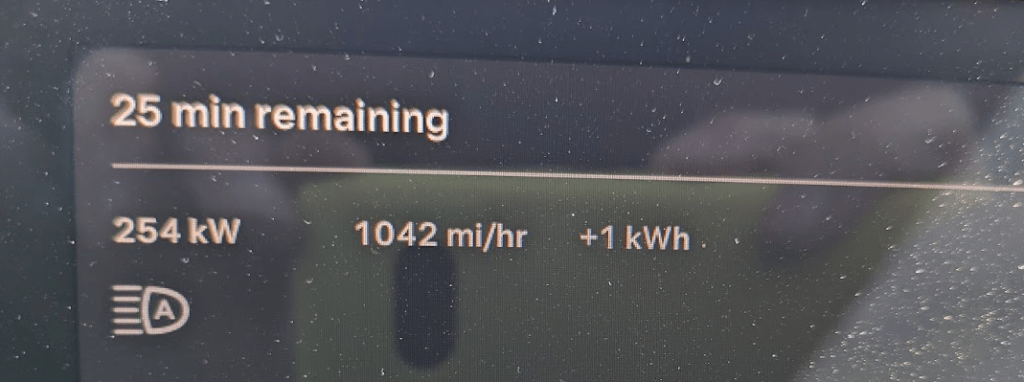
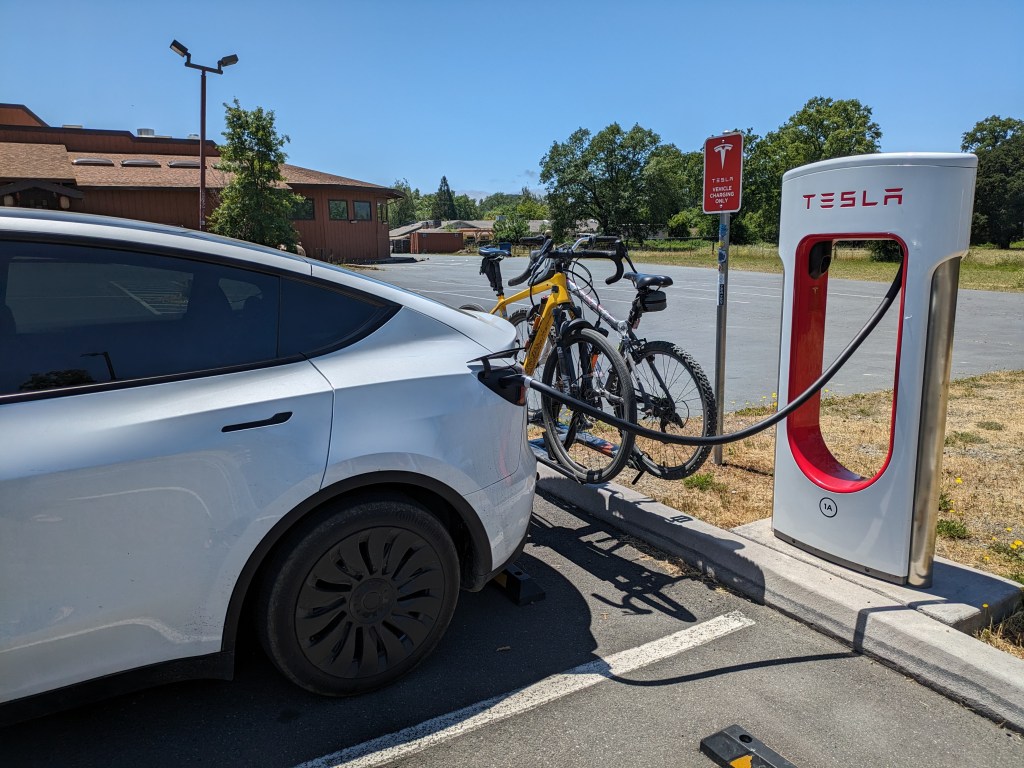
In the 12 months that I’ve been home since I got the car, I’ve driven about 11,000 miles/18,000 km. That includes road trips where I used Tesla’s supercharger network, and the occasional non-Tesla charger. The real world range is not as much as the rated range (320 miles/515 km), maybe it would be if I drove the speed limit! There are superchargers everywhere in California and my only complaint about them is that sometimes they’re so fast you have to rush lunch. Seriously, it’s an amazing infrastructure that Tesla has built.
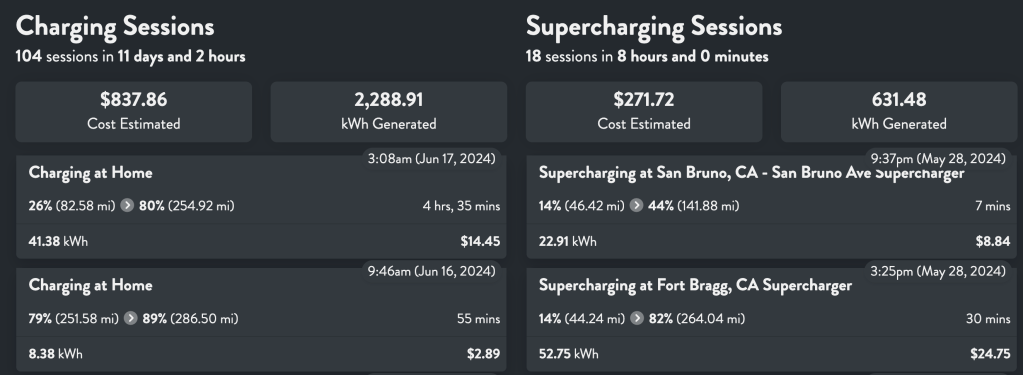
Mostly I charge at home. Despite charging for 7 months in 2023, our electric bill was still zero at the end of the year. Our solar panels had been generating excess and now I am using it to drive around. I didn’t expect that but love it. That really is cheaper than gas at any price per gallon!
The maintenance I’ve done is zero. Well, not really. I had to pump up the tires twice and fill the windshield washer tank twice. But nothing else. People say they burn through tires faster in a Tesla but they must drive more aggressively than I do. My treads are still deep and even on all 4 tires.
What surprised me owning an EV?
- My new appreciation for quiet driving. When I’m biking or walking or even driving, and I hear a loud car or motorcycle, it’s now annoying and I find myself wishing they were all electric!
- The AWD and extra weight, distributed evenly, down low, makes driving slippery dirt roads more secure than I’m used to. The car is just so quick and nimble it is amazing.
- I really appreciate how the car gets better over time. Not only do I track every driving and charging session (data nerd), but my car has upgraded itself 26 times. Not all of those upgrades were noticeable but the way the car works has definitely improved many times. [This might be a little Tesla-specific.]
- I have less guilt about driving and thus enjoy it more given that my car is powered by electricity that my house generates.
These might or might not apply to other people. And I will say that being a software professional really helps the transition to thinking of a car as a moving, internet-connected computer. Since I think like a software engineer, the leap to driving a Tesla was painless for me but I’m sure it could be difficult for others. Luckily, the other EV manufacturers seem to make cars like they always did, but with electric drive trains. Unlike with a Tesla, there isn’t so much new to learn and get used to. I have lots of friends who have bought or leased non-Tesla EVs recently.
Will EVs replace ICE (internal combustion engine) cars?
Yes they will. It is inevitable. I like to think of it this way: Suppose that all these decades we’d been driving EVs. From the Ford Model T and even before, all those cars were electric. Interesting side fact: Clara Ford drove a 1914 Detroit Electric car. She was married to Henry Ford from 1888 to 1947. Anyway, everyone would be used to EVs and charging at home. Then suppose someone came along and build a gas or diesel powered car. Suppose it was a pretty good, affordable one, like those available today. What are the chances of this technology upsetting the entrenched EV market?
Cons
- Fueling would be difficult, impractical at home and all the existing stations only sell electricity.
- Maintenance – everyone would be used to virtually maintenance-free EVs with just a fraction of the moving parts of ICE cars (I’ve read there are 100x fewer moving parts in an EV motor vs ICE, 20 vs 2000). Oil change? What’s that? Oil? What do you need that for?
- Air pollution – a car with an exhaust pipe? How dirty. Smelly too.
- Complication – Transmission, radiator, starter motor etc.
- Performance – comparing same price cars, EVs are zippier.
- Loss of storage space – no more frunk, it’s full of engine up there.
- Noise – Everyone would be used to quiet vehicles and disgusted at anything else.
- Sustainability – no contest.
Pros
- Tire life might be longer since ICE cars would be lighter.
- I can’t think of any more, maybe some people like engine noise, but not me.
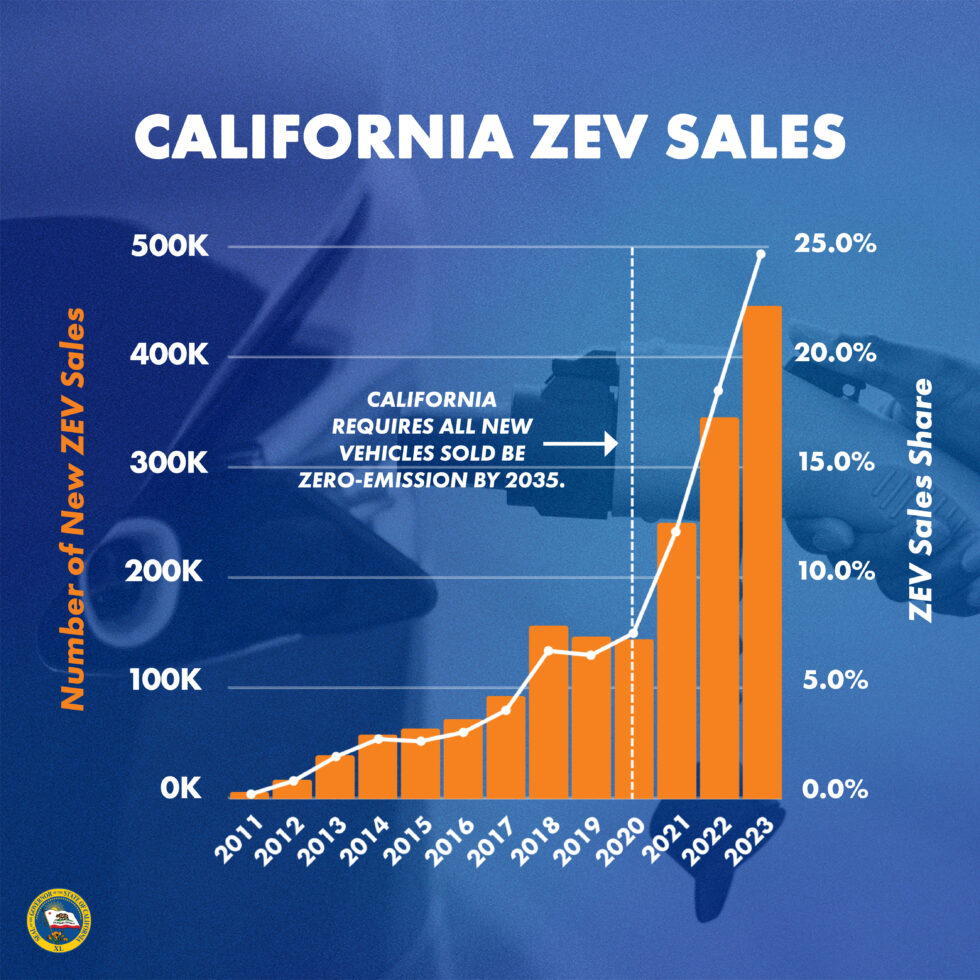
In short, the switch from EVs to ICE would not stand a chance. But the reverse is already happening now. Not overnight, but inevitably. We don’t all live in California, but there are many legal mandates to end the sale of vehicles with emissions by various dates. Even if these are not fully enforced or end up delayed, we will still get there, in my lifetime if I manage to stick around a while.
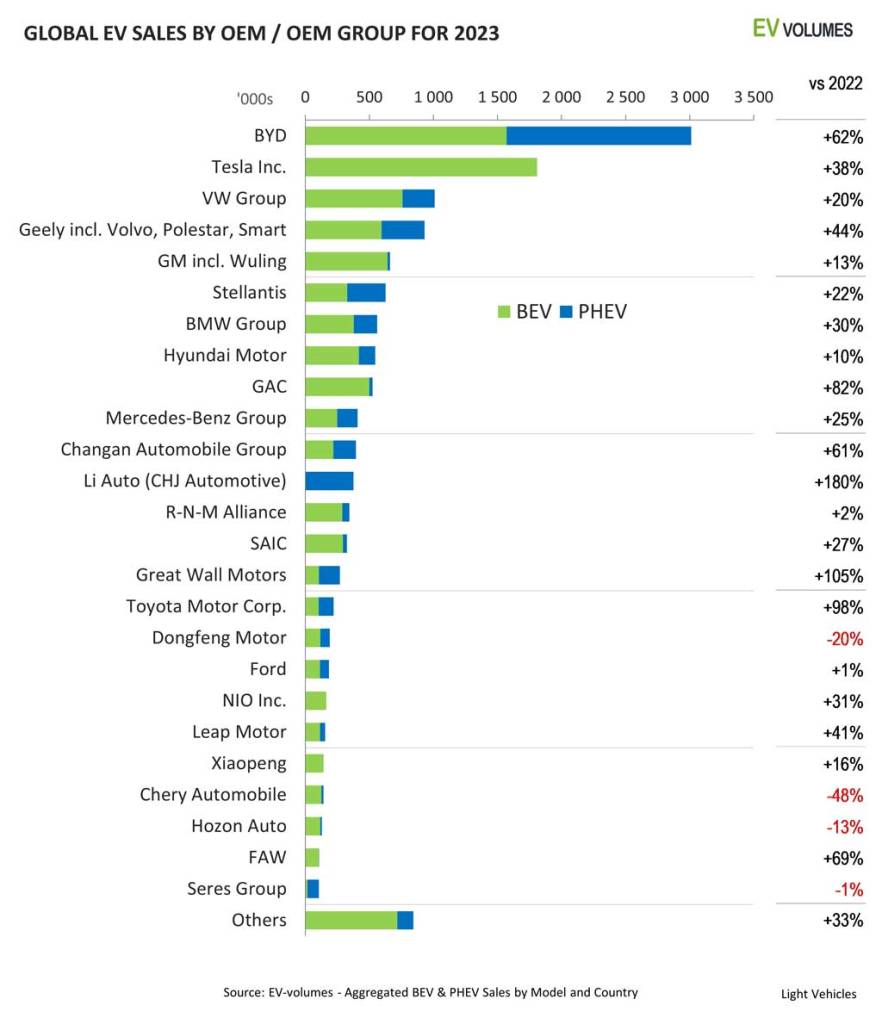
Globally, EVs are selling in the millions per year. In the chart below, green BEV means “Battery Electric Vehicle” and blue PHEV means a “Plug in Hybrid Electric Vehicle” with typically a pretty small battery and more complexity than even a standard ICE vehicle, but still somehow qualifying as electric, at least for now.
If you don’t believe me
You might like to borrow or rent an EV and try living with it for a week or two. You won’t need a fancy charger. You can plug in to 110V and charge at 1.2 kW which should net you about 40 miles of range in 12 hours – this should be enough to try it out. If you live outside the US, it would be double that speed at 220V. There are also public chargers that can charge much faster. A few are even free. You may be surprised at how much you like it!
 Nathan's Blog